The Metronome Heart
Fairy tale about a piano prodigy

Bettina had a metronome for a heart. Every night, when the city was softened by gas light and silence, she curled up beneath her grand piano and listened to her heart’s steady beat. There, under mahogany shadows, she dreamed in minor melodies. At dawn, when the wing beats of pigeons and starlings shook the skies, she sat at her piano and played the music from her sleep.
As a child, Bettina was as silent as smoke shadows. She couldn’t feel words. When her mother tried to coax her with rhymes and laughter, Bettina only heard jagged patterns. Her father stopped speaking her name, but her mother wrapped her in blankets the colour of forest winds and cradled her while a hush like empty churches swaddled their home. Bettina pressed her face to the cottage windows and saw the world outside only as rain dim and tree sway. Her mother, watching her silence, pressed felts and threads into her grasp and tried to teach her to sew, but Bettina couldn’t stitch. Her hands wouldn’t speak.
On a morning as grey as cloud fossils, the wind puddle-damp, Bettina gripped her mother’s hand and trekked through the village pathways to a grand house. Inside, beneath the carved ceilings and gilded air, she watched her mother unfold a bundle of velvet cloth. She felt the vast spaces of the house about her. No one was watching; she crept through a doorway and down a corridor. Shadows stretched the walls. The gloom felt like lost dusk. She stepped past archways and through an open door: the room seemed as long as field skies. A strange creature stood before her, the colour of polished night. Her metronome heart was loud. She climbed up onto the piano stool and stared; the keyboard was an open jaw. She reached out and pressed the keys. The creature’s song felt like herself.
Her parents gave her a piano: shabby and upright, with some keys silent. She gave it a name made of fluttering chords. Her hands filled the days with her voice. Later, after her parents had gone to sleep, she sneaked from her room through the chill dark to curl up against her piano. The nights smelled of worn ivory. In the mornings, she huddled by the window watching birds and clouds, before rushing to her piano to make her own words for them out of flowing notes. Villagers paused outside the cottage. One day, a music teacher came from the city and she was taken to a school.
She never went home. In the small cottage, the shabby piano’s silence felt like waiting words. Her mother wouldn’t close the lid. Dust dimmed the ivory keys. On the city edge, in the music school, Bettina’s days jumbled among symphonies and songs. The rooms smelled of sunlit paper. She filled her arms with sheet music and slept with pieces under her pillow. Other students gathered round when she played. Teachers whispered. When she gave her first concert, she felt the hall around her like a sealed cave; the audience’s murmurs sounded like jewel shadows. She played rivers and heights. In the morning, the newspapers printed her name.
Years went by. The city swelled with music, and high in the centre, lived Bettina with her piano. Her name brightened posters and her steps hushed concert halls. At parties, in gowns the colour of startled flowers, she moved through whirlpool crowds. Their voices were strange shapes. To understand words, she had to translate them into music: chatter became quavers and arpeggio leaps, and she lagged behind the ladies’ talk. She lingered by windows and listened to her metronome heart. She tried to peer into the night outside, but saw only her reflection. The air was stiff with champagne scent. Afterwards, at home, she played slow secrets on her piano.
She travelled to foreign lands which she saw only as glimpses from windows, rain-blurred and dim. In concert halls, before clamouring audiences, she played music of peaks and flight until applause broke over the stage. The noise felt like shattered notes. Her ears hurt. Her metronome heart was fast. Afterwards, she found herself ushered through crowds and begged for the secret of her talent.
“When I was very little, I didn’t talk,” she said. “I only played. And I played until I fell asleep with my head on the keyboard. I didn’t care about going outside. The pieces of music were cities and mountains which I wandered through and climbed.” But she didn’t tell anyone about her heart. She left parties early to sit alone in hotel rooms where listening to the night winds felt like eavesdropping, and there she slept in beds, longing for the weight and coolness of her piano’s shadow.
Her tour ended. She arrived home: her rooms smelled of crochet rests, and her piano sat in gloom, full of waiting melodies. She opened the curtains, sat in moon-splash, and played until dawn. For days, she stayed by her piano, the city shrinking into the distance. She didn’t feel her aching hands. She lived in a gliding world. In the streets outside, passers-by paused to listen and glimpsed her music like strange skies. They spoke her name.
One morning, there was a knock on her door. The Countess strode inside, smelling of furs and marble. Bettina remembered the first time she’d performed for her at the music school; she’d played louder to hide from her stare, the sonatas marble forests where she’d run pathless ways. The Countess stepped closer. Bettina sat back down at her piano.
“Bettina, you can’t keep yourself shut up in here. All of Europe is asking for you. As your patron, I wouldn’t be fulfilling my duties if I let such sublime talent rot away between these walls,” the Countess said, her eyes icicle bright. With a gloved hand, she closed the piano lid. “This tour they’re proposing – you will go.”
Weeks sped by: cities and days, railways and nights merged with train whistles and racing skies, flashing jewellery and raised glasses. Bettina felt far away. The countries seemed to be made from corners and laughter. In streets and parties, the chatter was like smashed octaves, so she tapped rhythms which felt like shelter. But in the concert halls, her hands on black and white keys, she played valleys and seas, different suns and endless plains. Her audiences threw flowers.
One evening, in a grand hall deep in a foreign city, Bettina walked on stage; the ceiling arched above her like unseen treetops. Applause shook the night. She sat at the piano and waited while the audience became quiet. Lamplight deepened the hush. Then music blazed from the orchestra. She felt wrapped in stained-glass colours, but when she put her hands on the keyboard and tried to race notes, her fingers moved too slowly. Violins sagged. Her hands played at half speed. The conductor stopped the concert. She ran from the stage.
She cancelled the foreign dates of her tour and travelled home. There, wrapped in blankets, she curled up beneath her piano, listening to her metronome heart. Her breath felt like stone. The room was cold and she didn’t sleep. She tried not to hear the night hush; it sounded like stopped concerts. Before dawn, she opened the curtains to watch the sunrise, but as she gazed at the smoke shapes and warming sky, she felt her heart slowing. She saw day speeding up until the streets were crammed with blurred colours. When the clouds began to redden, the city calmed. She closed the curtains. She stayed by the piano away from the windows. In the night hours, she played music as quiet as wind ghosts until morning seeped through the curtains.
“Bettina Klausner, what an honour. Your playing makes my wife weep,” the doctor said, ushering her to a seat. “Now, how may I help you?” Bettina sank into the chair and stared at her hands. Time stretched. Her thoughts jumbled in plummeting scales – she struggled them into words.
“There’s something wrong with me. Suddenly, I go cold and everything about me is rushing too fast – double speed. But, it’s not really fast at all. It’s me – I’m going too slow,” she said. And she told him about her heart. He listened to it.
“Your heart is running out,” he said. “I need to perform an operation to wind it back up, but it could get damaged, and I don’t know how that would affect your playing. If your heart is what makes you play the way you do, then…” The room seemed cathedral vast.
“I can’t lose the piano,” she said. Her words felt like the silent keys of her first piano. She remembered curling against it in the darkness of her childhood home.
“Perhaps you don’t understand how serious a matter this is.”
“I’m not having the operation. I can’t. Thank you for concern, but I’ve made my decision.”
Bettina found herself in the streets. She didn’t remember running from the doctor. She became cold. As she watched the pathways, the coaches and passers-by began to chase. The pale blue sky over the rooftops shimmered red and then blackened. She knew her heart had slowed down. Past the street lights, carriages stormed – she glimpsed ladies in furs and diamonds at the windows. Suddenly, the city trembled and settled into a normal pace. A carriage halted in front of her, the door opened, and the Countess climbed out.
Bettina, what are you doing here at this time of night?” she said, gripping Bettina’s hands. “You’re like ice.” She led Bettina to the carriage and sat her next to a lady draped in gems. The carriage jolted and moved through the city. Bettina pressed against the window and felt the night chill. The streets outside moved as hard shapes.
“I thought we’d never arrive,” the Countess said, as the carriage stopped before a grand house. Bettina peered out at towering archways and wide stone steps. The night smelled of lamps. She followed the Countess up the steps. Broad doors opened before them; the crowd inside was a surge of chatter and silk, chandelier glare and smoke. Shrill voices spoke her name. She saw people dancing slowly then faster and faster until they blurred and the candles behind them burned swiftly into stumps, and in the hallways and high on the walls the clock hands raced, and below the flurry and the din she felt the ticking of her metronome heart.
Dawn lit the windows and the city slowed. Bettina walked out into the street, among the crowd – she saw them point at the orange sky low on the rooftops. Someone was talking to her but she didn’t listen to the words. Winds stirred the empty pathways. Her coat felt thin. The street lamps had gone out. Someone was singing a song she didn’t know. Her feet ached. She lingered behind and watched the crowd wander away past the houses until they disappeared around a far corner. Then, her heart loud beneath the city’s silence, she began to walk towards the concert hall.
The day swayed about her, the sky turning blue and becoming faster with clouds while below the rooftops the streets brimmed until the people were just hurrying sounds. As she reached the concert hall, dusk bloomed. The world became steady once more. She stepped inside and moved through carpeted corridors which smelled of late nights. The air felt old. Her breathing was loud. Then out onto the stage, she walked. The audience was noise and colour. Her heart kept pace. She sat at the piano and played ocean depths and mountain winds, strange woods and soaring towers. The music wrapped around her like the passageways of a gilded city. She played and played, her hands fast, the melodies surging and filling the hall until the last chord. The audience were on their feet. She felt cold. She rested her head on the keyboard. She didn’t hear the cheers. Her metronome heart had stopped.
First published in Half Mystic.
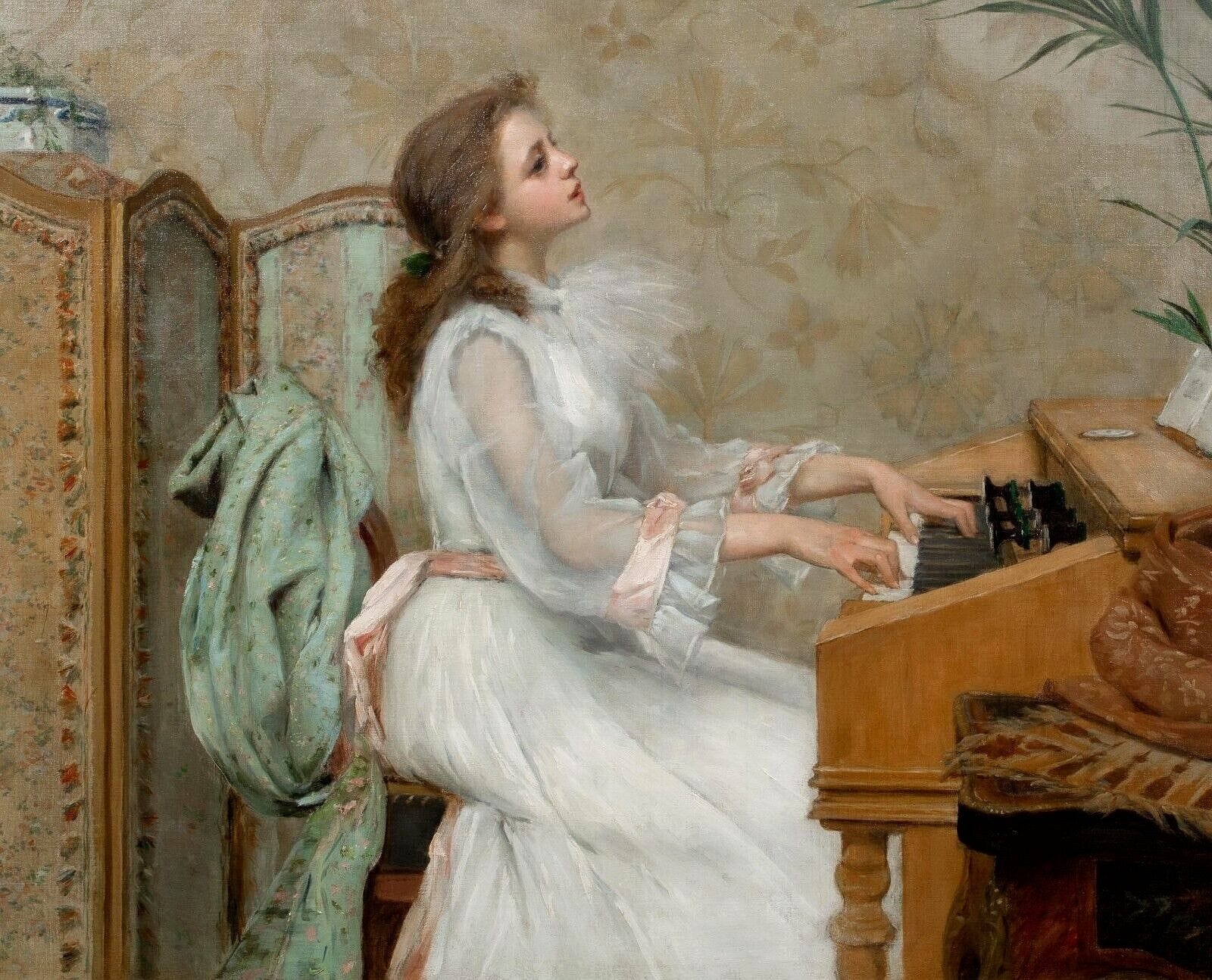
Art by Berthe Burgkan.
This was so lovely! Omg and the ending! Well done! 👏👏👏👏