He Beneath the Sea
Fun 80s horror story in the style of a paranormal podcast

Tasha: Hello and welcome to Episode one of The Perplex Files, with me Tasha Brindle.
Claudia: And me, Claudia Larkin.
Tasha: Come on in.
Claudia: Pull up a chair to the fire but not too close cos it’s getting whaaaaat in here.
Tasha: The weirdness is turned up to eleven today because for our first episode we’re visiting He Beneath the Sea. And have we got a smorgasbord of strange for you: seaside folklore, vanishing children, time leap Cockneys, aquatic beasts beyond time, and even aliens.
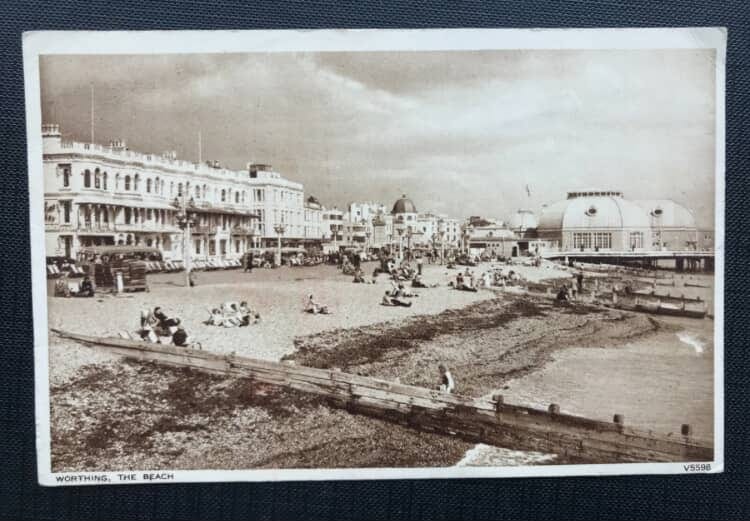
Claudia: Our destination is Worthing. Some call it the Grey Brighton, others God’s Waiting Room. There’s undoubtedly been a mass migration of the elderly to Worthing over the years.
Tasha: Maybe free bus passes only offer a one-way trip? Like a sandy gulag?
Claudia: Maybe. But picture Worthing in 1985: donkey rides on the beach, ice cream on the pier, fish n chips on the promenade. It was postcard Britain. Bring your bucket and spade. And Luke, or Little Luke as the newspapers called him, did. The front pages showed him standing proudly by his sandcastle, his spade in his hand. It was an idyllic image.
Tasha: I mean, look at that face. He’s jubilant. Two years old and his first trip to the seaside. All the photos will be up on the socials.
Claudia: Little Luke and his parents, Tracey, a trainee nurse, and Dave, a builder, had driven down from Birmingham that morning. The drive was long and tedious, but for an interlude at the legendary Little Chef.
Tasha: RIP Little Chef. Gone but not forgotten.
Claudia: When they finally hit Worthing, the tedium was forgotten. It was a glorious day: the sky was blue; the sea was sparkling; the sun had got his hat on. Luke, kept steady by his mum, rode a donkey.
Tasha: And he’s even happier in that photo, bless him. And look at the donkey. There’s just too much adorable in this pic for me. Please tell me no donkeys were harmed.
Claudia: Don’t worry the donkey population prevailed. The family had a perfect day with Mr Whippy cones at the end of the pier, and fish n chips on the beach, and even a stroll along the promenade with Luke slumbering in his pushchair. They were exhausted when they rolled into the seafront Bed & Breakfast. Luke was tucked in his cot bed immediately. Tracey curled up with a magazine. And Dave nodded off still in his clothes.
Tasha: In those days, hotels weren’t required by international law to provide televisions! That is a disgrace!
Claudia: Good job the UN eventually intervened on the telly issue. Anyway, Tracey must’ve nodded off in her clothes, too, because the next thing she knew, it was three o’ clock in the morning. And she felt an overwhelming sense of dread. She shook Dave awake. And while he frantically searched for something to use as a weapon, she gathered Luke up and clutched him. No one was going to take her Little Luke. They heard the swing of the front door. Then slow footsteps down the hall.
Tasha: See. This is when a telly would’ve come in handy. You can take anything out with a television to the head.
Claudia: Tracey and Dave never saw who or what took their child. They only saw the panicking faces of Mr and Mrs Goldman, the B&B owners, as they were shaken awake three hours later. The bedroom door had been wide open with Dave in a heap on the floor, clutching, of all things, a toilet brush.
Tasha: If you’re of a certain age, all you need is to hear those two words Little Luke and you’re transported back to the Summer of 85. He was literally everywhere and nowhere.
Claudia: For a fortnight, the entire nation searched for Luke. His cherubic face grinned from news bulletins and missing-child posters. Tracey and Dave made heart rending pleas. Ports were searched. The Prime Minster, Maggie T, even made an appeal for his safe return. For two weeks, he was all anyone talked about.
Tasha: Then another child disappeared.
Claudia: Jennifer Corbett. Nine years old. Vanished from her bedroom.
Tasha: Then another child. Jamie Smith. Four years old.
Claudia: Until every night a child was vanishing into thin air. Worthing was in turmoil. Posters of missing children littered the promenade. There was a curfew. When seven o’clock hit, the streets were empty, but for bobbies on patrol. And in case you forgot, warnings were broadcast on local radio every hour until morning.
PC Bluet here. Just a reminder to stay safe. Remain in your home. Keep all your doors and windows locked. The police have got matters in hand. Remember, we’re all in it together. Ta ta.
Tasha: Nothing instils confidence like a ‘ta ta’.
Claudia: Indeed.
Tasha: Imagine cowering in your home, terrified your children will be next, and that comes on the radio. You know you aren’t safe. You know you can’t protect your children. You know you’ll be unconscious when they’re taken from your arms.
Claudia: Look at the flyer they sent round. There’s a picture of a lock on the cover.
Tasha: Because I’m certain people weren’t locking their doors. Talk about useless. It’s on a par with paint yourself white to deflect the blast.
Claudia: On that note, the 80s wasn’t just the era of leg warmers and mullets.
Tasha: And the best tunes.
Claudia: It was also the era of the Cold War, the bomb, and Protect and Survive.
Tasha: Think about it – shadowy figures are stealing Worthing’s children. And no one glimpses them. Anyone present is rendered unconscious. How? Were they gassed?
Claudia: Well, not according to the toxicology tests. But what did that mean? Who knows what chemical weapons they possessed?
Tasha: And who could have chemical weapons unknown to us but Russia.
Claudia: You didn’t include WW3 in your description.
Tasha: That’s because we avoided it. But here’s a recording of the Prime Minister’s Question Time showing just how hairy things became. Let’s just say you wouldn’t have been overreacting if you’d invested in those cans of white paint.
- Order. Order. Neil Kinnock.
- Mr Speaker, is the Prime Minister aware of the crisis unfolding in Worthing? The mass abduction of children and the use of chemical weapons on British citizens! They’ve been left unprotected but for a few bobbies on the beat. Would the Prime Minister now make a public apology for this gross incompetence?
- Hear. Hear.
- No Mr Speaker, there hasn’t been any confirmation that chemical weapons have been used.
- Mr Speaker, does the Prime Minister think that in any way excuses leaving the people of Worthing to fend for themselves in their darkest hour? Does the Prime Minister think there’s any other explanation for the victims falling unconscious before their children were snatched from their very arms?
- Hear. Hear.
- Mr Speaker, does the Prime Minister think that there’s any other explanation for this attack on the British people other than the malice of our greatest enemy?
- Mr Speaker, I have the President’s agreement of support for Britain should there be any evidence of the USSR’s involvement.
Tasha: And the army rolled into Worthing that very afternoon.
Claudia: We’ve all seen the photos a million times. Tanks rolling past the pier. It’s iconic. It’s like daleks on London Bridge.
Tasha: Except these are the good guys. Worthing will be safe now, right? Right?
Claudia: Well, that’s exactly what Silvia Cleeves thought when a tank settled on the edge of her cul-de-sac. She was so relieved she even took over mugs of tea and a plate of Jaffa Cakes which were wolfed down. The neighbourhood kids played hopscotch and the grown-ups nattered. Silvia’s thirteen-year-old son, Andy, put his boom box on their drive and blasted out the hits. It was almost a street party.
Tasha: And the jubilation continued after curfew. Silvia’s eight-year-old daughter, Sarah, waved to the soldiers from the living room window. And they waved back. Since it was as good as a holiday, Silvia decided the kids could stay up late. And so, they did. The family ate supermarket pizza and played snap. Everything was going to be alright.
Claudia: But come sunrise, Sarah was gone. The three remaining members of the family were found slumped in the living room, playing cards in hand.
Tasha: Fat lot of good the tank was.
Claudia: The tank was fine. The soldiers not so much. They’d fallen unconscious.
Tasha: So now things were really serious. Temperatures were rising in the House of Commons. You might say they were thermal nuclear.
- Order. Order. Neil Kinnock.
- Mr Speaker, last night our troops in Worthing suffered a chemical attack. Would the Prime Minister admit that, despite Gorbachev’s repeated denials, this was a declaration of war?
Tasha: Crikey! Where’s a bunker when you need one?
Claudia: Under the Houses of Parliament, I presume. Not much use to the rest of us.
Tasha: I’ve got to say, I’d make a fantastic Leader of the Opposition. I can see it now, the press would nickname me The Rottweiler.
Claudia: No doubt, you’d be fab. But you’d be a rubbish Prime Minister. The briefcase containing the nuclear button would just be lost under a mountain of crap, and you’d accidentally nuke Australia.
Tasha: You win some, you lose some.
Claudia: The Prime Minister announced that if there was an incident that night, then she’d consider us at war.
Tasha: But we had the USA on our side so…
Claudia: We’d be swiftly incinerated in the crossfire.
Tasha: It was September by now and Summer was rolling to its end.
Claudia: Maybe taking with it the entire world.
Tasha: The nights were drawing in, and John Danvers was watching what was possibly the last ever sunset. John was a journalist with the Worthing Herald whose son, Neil, was among the missing. As the sky turned black, John felt an overwhelming conviction that Neil was at the beach. He couldn’t explain it. But let the tanks try and stop him reaching his son.
Claudia: Luckily, his journalistic instincts were still in play, and he grabbed his bag with his camera and tape recorder on his way out.
Tasha: But he wasn’t the only one. All the parents of the missing children felt the same conviction. All of them had left their homes and were hurrying down the streets.
Claudia: Seventy-three children had been taken. Snatched from their parents. Leaving no trace behind. Spirited away as if by magic.
Tasha: As John reached the beach, he saw them: a crowd of silent children under the rising moon. He frantically called his son’s name. And then he found him. Neil looked at his dad like a stranger. He seemed to be in a trance.
Claudia: None of the children spoke until they were ‘woken’ by their parents. And then they wailed. And cried. But they were safe. That was what mattered. All of the children were back. All seventy-three of them.
Tasha: And this is where things get weird.
Claudia: Because it hasn’t been weird yet?
Tasha: Seventy-three children had been taken. But a hundred and one had returned.
Claudia: Du du duh.
Tasha: And those extra kids were still silent and staring because they had no family to wake them up.
Claudia: Thanks to John Danvers journalistic instincts, there are photos, but be warned, you may never visit the seaside again. So only check them out if you’re ready to hang up your bucket and spade. Those kids were creepy with a capital C. And when they woke up, it got worse.
Tasha: Here’s an except from John’s recording.
-What’s your name?
-Liz Willow
-Where were you, Liz?
-I was with he beneath the sea.
Claudia: That’s where the phrase comes from. The BBC thieved it for their 1993 kids ghost drama. And then the programme was a classic, so everyone forgot the origin.
Tasha: Total classic. ‘He Beneath the Sea’ got me into horror. Which led me here, so…
Claudia: Chain of gold or chain of thorns?
Tasha: Gold, obviously.
Claudia: The next day was a busy one. The world hadn’t ended. Thatcher sent a grovelling apology to Gorbachev. The tanks rolled out of Worthing. But now the hunt was on for the families of the mystery children. Their photos were all over the papers, all over the news.
Tasha: Why wasn’t anyone coming forward? No one knew them? No one in the entire country? Not even a neighbour or a teacher?
Claudia: No one. The children weren’t even in the system. There was no record of them. And they were certainly British. The BBC shoved Liz Willow on their daytime prog Pebble Mill, and just listen to her.
-First time in a television studio, Liz, but you’ll get used to it.
-Ain’t it afternoonified, Miss.
Claudia: Talk about cor blimey, gov.
Tasha: For our listeners who aren’t into Victorian slang, afternoonified means fancy. And the studio really wasn’t. But why was Liz using Victorian slang in the first place?
Claudia: And this is where our journalist friend makes a reappearance. An appearance on Radio Worthing none the less.
-And next we have John Danvers from the Worthing Herald. John, one of the missing children was your own son!
-Neil’s home now and he’s alright. It’s the others.
-The mystery children. No one’s found anything. It’s like they don’t exist.
-No one’s looking in the right place.
-And you are?
-I’ve got a copy here of Liz Willow’s birth certificate. She ought to be a hundred and thirty years old.
Tasha: Maybe Liz just aged well. All that smog kept out the sun. Stopped the wrinkles.
Claudia: It wasn’t just Liz. John had birth certificates for several of the children. And they weren’t fakes. They’re still in the archives. But there was no real evidence that they were anything other than coincidental names. Until John uncovered the murder of Janet Barge.
Tasha: On the morning of July 5th 1863, Janet Barge was found strangled to death in her own home, the door wide open. Her neighbour, Michael Ferris, a baker, was charged with the crime. He was convinced that Janet had drowned his son in the sea. He said ‘Come morn, she was dripping sea water and another child gone, gone like my son was gone.’
Claudia: For weeks, a child had vanished every night. Just like in 1985. Twenty-eight children. We won’t read out all the names, but we’ll put both lists on our socials.
Tasha: Twenty-eight children went missing in 1863. And returned in 1985.
Claudia: And after Janet Barge’s murder, no more children vanished. So, was she involved? Had she carried them into the waves? Had she taken them to ‘he beneath the sea’? And why? Janet was described as a tender-hearted young woman, good with little’uns and elderly donkeys.
Tasha: Clearly, a monster.
Claudia: Indeed.
Tasha: When you were a teenager, did you ever do any of those witchy things supposed to summon visions of your future husband? Like combing your hair and eating an apple in front of the mirror?
Claudia: Nope. Too tame. It was Bloody Mary at my sleepovers.
Tasha: In Worthing, they say ‘sleep with sea glass on your eyes and you’ll dream your true love’.
Claudia: Does it work?
Tasha: It didn’t for our guest. She wishes to remain anonymous, so we’ve disguised her voice.
Claudia: She’s going by Debbie today.
Tasha: All names have been changed.
Claudia: Hi Debbie, welcome to The Perplex Files. Thank you so much for talking to us. How were you involved?
Debbie: Let me put you in the picture – the monster was my sister. Doesn’t everyone say that about their siblings? But for me, it was true. And the worst thing was – it was all my fault. We were twins, but like chalk and cheese, as cliched as that sounds. Truth is, I went out of my way to be Mel’s opposite. She was into those puffball skirts and perms. I wore black and lace. Looking back, I can see I was trying to create my own identity. We’d always been ‘the twins’. And I was fourteen, I wanted to be me. Of course, now I love being a twin, but back then it drove me bonkers. And it got worse when Daniel Selborne moved to our school. I was fourteen. And he looked like the bad boy in a boy band.
Tasha: Puppy dog eyes and a leather jacket?
Debbie: That was him. I wrote his name in my diary. I doodled hearts in my schoolbooks. I nicked my mum’s Elaine Paige tape and listened to I Know Him So Well over and over. He was my first love. Problem was, Mel liked him, too. And she wouldn’t back off. She told me she was going to kiss him at Jessica’s party that weekend. She was the pretty twin. The popular twin. I didn’t stand a chance.
Claudia: What did you do, Debbie?
Debbie: Round here, they say if you sleep with sea glass on your eyes, you’ll dream your true love. Daniel was meant for me, not Mel. I thought she’d forget all about him if she saw her husband to be. I had some sea glass in an old jewellery box. We shared a bedroom, so it was easy. She slept. I put the sea glass on her eyelids.
Tasha: Did it work?
Debbie: When I woke up, she was standing there in wet pjs. She was in a trance. I shook her. She barely spoke. She was cold. I ran a bath for her. I didn’t want to leave her on her own, so I read Smash Hits to her as she thawed. Her eyes were so sad. It was my fault. It had to be. I felt terrible. But then she snapped out of it. She was the old Mel again. And then there was the news about Little Luke. We helped look for him.
Tasha: Mel wasn’t sad anymore?
Debbie: Nope. Not until I found her like that again two weeks later. I made porridge for her and kept topping up her bowl with golden syrup. Her eyes were haunting. I’d never seen anyone so sad. But then she snapped out of it again. And there was news of another missing child.
Claudia: Did it strike you as odd that her episodes coincided with children vanishing?
Debbie: Not at first. But then she was like that every morning.
Claudia: Every morning after a child was taken.
Debbie: Mel was my sister, my twin. I loved her to bits even when I hated her guts. She wouldn’t have hurt a fly.
Tasha: But that was before you put sea glass on her eyes.
Debbie: I thought she’d stop. But the weeks went by. And every morning, I found her like that. And she didn’t even remember. She looked at me like I was barmy. Even when I showed her the pyjamas. She thought it was a practical joke. She said I’d soaked them in the bath and poured salt in the water. And how could she have got out anyway? There was a curfew.
Tasha: Did you tell anyone?
Debbie: Who’d have believed me? It all sounded so bonkers, even before…
Claudia: Before what?
Debbie: Before I followed her.
Tasha: Where did she go?
Debbie: Just through the streets. She didn’t stick to the shadows. She wasn’t hiding. Then she stopped in front of a house. The front door just opened for her. I watched her go inside and come out holding a little boy. He wasn’t struggling. I couldn’t believe it! It was her! She was the monster. My twin sister! My chest was this ball of dread. I ran to her. I tried to wrestle him out of her grip, but her arms were like steel. She just walked. I shouted for help. No one came. I followed her to the beach. I screamed at her. I hit her. She kept walking towards the sea. I pulled at her clothes. They tore. She kept walking. The waters parted for her like a book. There was a path. She went down into the sea. She came out alone.
Claudia: Why didn’t you fall unconscious?
Debbie: I was her twin. That’s all I can think. That morning I couldn’t touch her. I couldn’t run a bath for her or make her porridge. Not after what she’d done. The army arrived. Everyone was happy. Everyone thought it would be over. I knew better. I knew she wouldn’t stop. That night, I took my polaroid camera with me. I needed evidence.
Claudia: Debbie has kindly allowed us to publish her photos, on the condition we blur her sister’s face. Be warned, you may find them distressing.
Tasha: How did the water part like that? How is that even possible?
Debbie: I showed Mel the photos. She was distraught. She thought she was a child killer. I told her it wasn’t her fault, and I was to blame because I put the sea glass on her eyes. Now the spell, or whatever it was, had to broken. But that night, she went out.
Tasha: Now you had the end of the world on your shoulders.
Debbie: She stole a girl. I followed her to the beach. How was I going to stop her? The sea glass was in my pocket. I found a rock. I smashed the sea glass. Then I heard him.
Tasha: Who?
Debbie: He beneath the sea.
Tasha: We’re just pausing the interview to prepare our listeners. Guys, what you’re about to hear will blow your minds.
Claudia: We’re about to solve the mystery of He Beneath the Sea.
Tasha: Because it didn’t begin in 1985 or even in 1863. It began a long, long time ago in a galaxy far, far away.
Claudia: What did you hear, Debbie?
Debbie: It pinned me to the ground and shook through me. My legs went to mush, but I struggled to my feet. I had to stop Mel. The sea was churning wild, and he was speaking to me, but not words.
Tasha: What was he saying?
Debbie: He wanted children. And Mel was carrying that girl to him.
Tasha: The end of the world girl.
Debbie: I asked him why. He showed me. I saw his memories. There were stars, and he was among them like he was in space. I saw Earth but the countries were joined up wrong. And then he was in water – oceans. And the things in the oceans, the trilobites were his – he brought them here from wherever he’d come from. I saw later on, and there were so many of them. But then they started dying. Then they were all dead. He grieved and his tears became the sea glass.
Claudia: So when you put them on Mel’s eyes she connected with his grief.
Tasha: And she brought him replacement children.
Debbie: I told him he had the wrong children, that they weren’t his. That he couldn’t get his back. He rose up. He was so vast, it felt like he was rising out of the water forever. He looked just like them. I was terrified. Then he opened a great jaw. Inside he was some kind of machine, but he was alive. The children walked out of him. Then he gave a great cry and sank beneath the waves.
Tasha: So, there you have it, listeners. He Beneath the sea was a sentient spaceship from millions of years ago.
Claudia: When you’re next in Worthing, having an ice cream on the pier or a stroll along the promenade, just stop and listen. And you might hear a mechanical monster from before time grieving for his children at the bottom of the sea.
Rebecca, this is so good. 💖 Really it would make a brilliant novel. Or a Netflix miniseries, something like Bodkin.
Cool, creative format. Enjoyed this tons 💜👾